 |



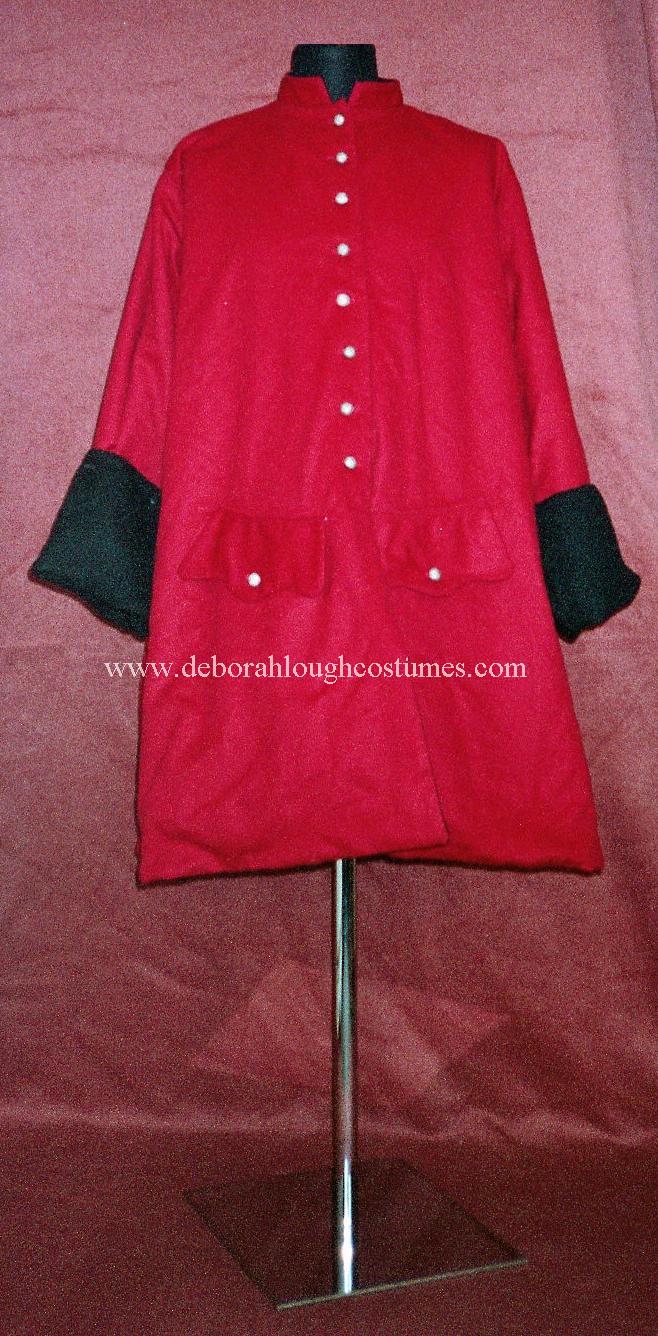




| Three coats, illustrating two styles of 17th century greatcoats (overcoats). All are made, and lined, in wool by Hainsworths, and fasten by means of hand cast pewter buttons. All have pockets with button-down flaps. The (red) coat on the right, and the dark green coat, second from the left, are 'Dutch Coats', (sometimes mistakenly called 'Brandenburgs'). These coats are known as Dutch coats because they were brought back to England from the Low Countries after wars in Europe. This version is based on an extant garment, and has large 'bucket' cuffs, which button back, and a rear vent which can be buttoned closed in cold weather, or worn left open for riding, etc. The coat is roughly knee or calf length. The (blue) coat on the right actually is a 'Brandenburg', also known sometimes as a 'Polish coat'. This has frogging at each button (metallic lace (or braid), in this instance - it's a style of decoration originating in the area surrounding Brandenburg, hence the name). This coat too has turn-back cuffs, though they are smaller. It is also trimmed with fur at each edge (fake fur in this instance). These coats are full length (i.e. ankle length), and, although this one doesn't, they can have a rear vent to enable riding. The Brandenburg can also be lined with fur (or fake fur). |
 |
 |
| Two soldiers of the English Civil Wars, portraying John Bright's Regiment of Foot. Ordinary soldier's clothing of this date is quite difficult to research. It is long before any specific uniforms regulations are written, so the only sources available are contemporary written accounts, and scarce pictorial sources. Virtually no clothing of 'the common man' survives from this period. Due to this lack of evidence, the truth is that nobody can really be 100% certain what soldiers actually wore. We know from records of clothing issues that there was a uniform, and some of the items that were issued, but even then, the records are not clear on many issues (for example, there may be an issue of a 'cap', but it does not state what kind of cap - it was simply not necessary at the time). So by definition, these outfits can be educated guesses at best. Both soldiers wear grey coats, made in wool, and lined in green wool (visible at the cuff turn backs). Both of these coats are fastened by means of tape ties. The use of ties of this type relates to a clothing issue that mentions 'tapes'. My personal opinion is that buttons would be a more likely fastening, but as no one knows for sure what those tapes were, this is as valid a theory as any. As seen in the few pictorial sources, both coats are loose and almost completely unfitted, although very slightly shaped at the waist. The soldier on the left wears 'cloak bag' breeches, which fasten below the knee. These are made in grey wool and lined in linen. He also wears a dark red 'bonnet' style of cap, made in wool and lined in linen. The soldier on the right wears 'Dutch' or open legged breeches, made of dark green wool, and again lined in linen. He wears a type of cap known as a 'montero'. This particular version has two flaps tied over the forehead, which can be folded down in colder weather. This design is based on one shown in a source known as the 'Farndon window'. Both soldiers also wear linen shirts (unseen), and hosen (stockings), cut from woollen cloth. |
| This is a gentleman's doublet of the mid 17th century, made for a 'commanding officer' in the English Civil War Society. It appears to be black in the photo, but is actually a very dark rifle green. (As with the coat worn by Keanu Reeves in 'The Matrix', the camera could not pick up the colour properly, so it looks black!) The doublet is completely lined in off-white linen (as can be seen on the reverse of some of the tabs), and trimmed with maroon coloured braid. The numerous buttons are hand cast pewter by Cristophus. The sleeves are buttoned because they are slit nearly up to the armpit, and can be worn closed, entirely open, or partly open. The wool is by Abimelech Hainsworth. |
| Yet another gentleman's doublet, this one made for a staff member at Bailiff Forge. Again it is in wool by Hainsworths, and fully lined in linen. This one has open sleeves, and the simplest of braided decoration in a darker shade of blue. There are also holes at the waist to support ties from the breeches (though in the photo it is worn with jeans). |

| A selection of soldiers' coats, showing slightly different styles and details. Again they are all in wool. The coat to the extreme left , is grey lined in green wool, the colours of John Bright's Regt. of Foot, of the English Civil War Society (ECWS). The left coat is in grey wool lined in off-white linen, and fastens with pewter buttons. It was made along with a number of others for Colqhoun's Company in the ECWS, when they re-coated. The coat to the right is of red woollen fabric, lined in off-white linen, and fastens with pewter buttons. The coat to the extreme right is of black wool, lined with red linen. The cuffs turn back to show the colour of the lining, and it fastens by means of pewter buttons. |
| Cloth hosen (stockings). Or in other words, hosen cut from cloth. Both of the pairs in the picture are of woollen fabric, but they can also be of linen or silk (if you're really posh!). They are based on an original piece. After months of playing around with |
| Another style of montero cap, (an officer's version this time, hence the gold lace). |
| This style is based on a picture in a 17th century drill book. It is made in wool by Hainsworths, fully lined in linen, and is trimmed with gold military lace. |
| A pair of 17th century 'cloak bag' breeches made for the Royal Armouries at Leeds. These are of wool, fully lined in linen, and fastened by hand cast pewter buttons. These breeches are made to a pattern from 'The Cut of Men's Clothes'. |
| An ordinary man's shirt, made in off-white linen. The collar and cuffs are attached at the customers request, and the cuffs are fastened by hand made thread wrapped buttons. |
 |


| it, I managed to adapt the pattern to modern sizes. Hosen are therefore one of the few items that we can supply from stock (unless you need silk, hand sewn or finished, or huge numbers of them, in which case they're to order). They come in five sizes, which cover (UK) shoe sizes 3 to 15. |

 |
 |
 |
 |
 |
 |
 |

 |
